


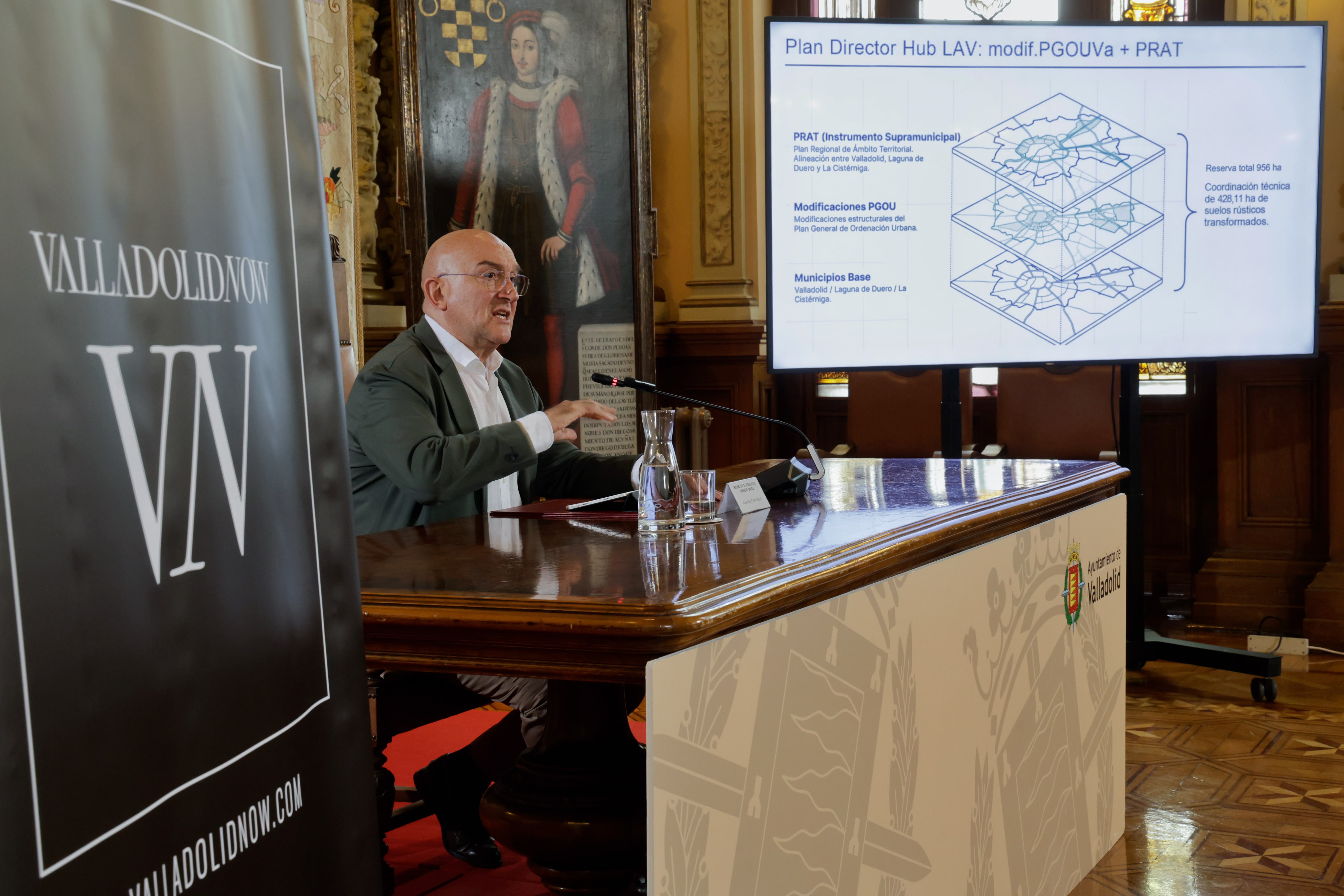
- From now on, the project moves from the strategic planning phase to the development and implementation stage, consolidating its position as one of the flagship initiatives set to strengthen Valladolid’s industrial, logistics, and agri-food leadership both in Spain and across Europe
- It provides for the reservation of nearly 960 hectares of productive land through to 2050, is expected to mobilise more than €273 million in urban development investment, and will enable the creation of 30,000 jobs
La Junta de Gobierno of Valladolid City Council has today approved the Master Plan for the Valladolid Agri-Food Logistics Hub (Hub LAV), bringing to completion an extensive strategic planning process led by IdeVa (Valladolid Innovation and Economic Development Agency) in collaboration with municipal departments. The plan provides the city with a benchmark framework to guide its logistics, industrial and agri-food development over the coming decades.
The approval of the Master Plan marks a decisive milestone for Valladolid’s economic future, establishing the technical, legal and organisational framework required to develop strategic reserves of productive land in an orderly manner, coordinate the necessary urban and territorial actions, facilitate public-private collaboration, and strengthen access to national and European funding programmes, including the Connecting Europe Facility (CEF).
The Mayor highlighted: “With its approval, Valladolid now has a solid roadmap, backed by institutional and business consensus, technically robust and economically viable, to reinforce its economic leadership at regional, national and European level. Hub LAV is designed to transform our city into one of the leading logistics, agri-food and industrial hubs of the European Atlantic Corridor, capable of attracting national and international investment, generating high-quality employment and maximising the value of its industrial and land resources.”
The next steps will focus on preparing the ground for major European funding opportunities, creating the productive land envisaged in the three phases of the strategy through amendments to the Urban Development Plan and the Regional Territorial Project framework, and requesting renewed momentum for the Atlantic Corridor in recognition of Hub LAV’s strategic role.
Exceptional economic return
The Master Plan confirms that Hub LAV represents one of the highest-return economic development initiatives currently envisaged in Castilla y León.
The economic and financial analyses included in the document highlight the project’s exceptional capacity to generate economic activity, attract business investment and create employment, positioning it among Spain’s most significant territorial development initiatives.
As the Mayor stated: “The data show that Hub LAV is far more than an urban development project. It is a genuine economic transformation strategy capable of increasing business competitiveness, strengthening Valladolid’s industrial base and consolidating its leadership as a logistics node within the Atlantic Corridor.”
Key indicators
- 956 hectares of new strategic productive land reserves planned through to 2050.
- €273.57 million of estimated investment for urbanisation and development.
- More than 29,600 jobs, including approximately 13,300 jobs during construction and over 16,300 permanent jobs linked to new economic activity.
- Net Present Value (NPV): €6.893 billion.
- Internal Rate of Return (IRR): 43.4%.
- GDP growth exceeding €13 billion, combining the effects of construction activity and induced economic development.
- More than €370 million in fiscal impact, including revenue generated during construction and recurring annual property tax income exceeding €70 million once the Hub is fully operational.
- Estimated reduction of more than 63,000 tonnes of CO₂ per year, driven by the increased use of rail freight transport.
A collaborative and consensus-based project
One of the Master Plan’s key strengths has been its extensive stakeholder engagement process.
The plan was developed through consultations involving public administrations, universities, business organisations, logistics operators, railway entities, agricultural associations, trade unions, technology centres and leading companies from Castilla y León. Of particular importance was the contribution of participants in the Municipal Automotive and Agri-Food Roundtables, whose input helped define both the scale of the project and its governance model.
Participating organisations included leading companies such as Renault Group, Michelin, Iveco, Horse Powertrain, Grupo Entrepinares, Patatas Meléndez, Mercaolid and Centrolid, together with ADIF, CEOE Valladolid, Valladolid Chamber of Commerce, CARTIF, FACYL, CyLoG, and numerous representative organisations from both strategic sectors.
Coordination with the Regional Government of Castilla y León
The City Council also emphasised the close cooperation maintained with the Regional Government of Castilla y León throughout the development of the document.
Several regional ministries and agencies responsible for the economy, industry, transport, logistics and territorial planning played an active role, ensuring full alignment between the municipal strategy and regional planning objectives.
The Master Plan also envisages that the structural development of the Hub may be implemented through a Regional Territorial Action Plan (PRAT), coordinated with amendments to Valladolid’s General Urban Development Plan, creating a fully integrated territorial planning model between the two administrations.
Positioning Valladolid within the Atlantic Corridor
The approval of the Master Plan strengthens Valladolid’s ambition to become one of the principal logistics nodes of the Atlantic Corridor of the Trans-European Transport Network (TEN-T).
The document highlights the significant opportunities arising from ADIF’s new intermodal terminal, connections to both the Atlantic and Mediterranean Corridors, the potential to shift more than one million tonnes of freight annually to rail transport, and the development of new specialised logistics platforms.
Hub LAV will enhance the competitiveness of regional industry, improve logistics efficiency for businesses, support freight transport decarbonisation, and reinforce Valladolid’s role as a strategic platform for trade flows between northern Spain, Portugal and the rest of Europe.
A framework for legal certainty and accelerated investment
The approval of the Master Plan provides the project with a stable reference framework that offers legal certainty both for public administrations and private-sector operators interested in establishing new activities.
The document sets out a territorial planning roadmap, defines the necessary urban planning instruments, proposes a public-private governance model and establishes an indicative development timetable through to 2050.
This planning framework will facilitate the attraction of industrial, logistics and agri-food investment by anticipating the availability of productive land and reducing uncertainty in business decision-making.
International investment outlook
The Plan provides Valladolid with a strategic document designed to meet the expectations of leading European logistics platforms and support international investment promotion efforts.
Logistics operators, investment funds, industrial developers and international institutions will be able to access a project supported by a robust technical framework, a clearly defined planning strategy and a long-term development vision.
Ultimately, the approval of the Master Plan marks the beginning of a new phase for the Valladolid Agri-Food Logistics Hub, moving from strategic planning to development and implementation, and consolidating its position as one of the flagship projects set to strengthen Valladolid’s industrial, logistics and agri-food leadership in Spain and across Europe.